The Honorary Napoleons
Biographies
_______________


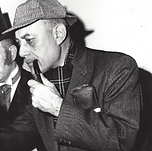


Vincent Starrett – I
Vincent Starrett (October 26, 1886 – January 5, 1974) was a poet, newspaper reporter, mystery writer, columnist, bibliographer and self-styled DOFAB or Damned Old Fool About Books. Born in Toronto, he lived in Chicago where he was a fixture in used and rare bookshops for seven decades. Starrett’s cornerstone Sherlockian works are The Private Life of Sherlock Holmes, "The Unique Hamlet," a short pastiche, and 221B, Studies in Sherlock Holmes. The first of these (1933) established him as an expert on Holmes's life and times and caught the attention of Christopher Morley, who invited him to the first formal Baker Street Irregulars dinner. Although Starrett never visited New York again, he and Morley remained lifelong friends. In 1944 he received the investiture of “A Study in Scarlet.”
(Raymond H. Betzner)
Roland Hammond – II
Roland Hammond was born on July 29, 1875, in Bellingham, MA. He received his medical degree from Harvard in 1902 and around that time became a fan of Sherlock Holmes. Dr. Hammond had a long career as an orthopedic surgeon at several Rhode Island hospitals, retiring in1947. During World War I he served in the Navy Medical Corps in Newport, RI, Ireland and London. He retained his reserve commission and retired as a lieutenant commander in 1938. He was a member of many New England medical associations and enjoyed gardening, music, art and travel. Dr. Hammond spoke at the 1944 Baker Street Irregulars dinner and received the Titular Investiture of “Silver Blaze” the following year. His presentation “The Attempted Mayhem of Silver Blaze" at the 1946 dinner, which drew upon his orthopedic expertise, was published in The Baker Street Journal. In 1946 he founded and named The Dancing Men of Providence, assuming the post of Dancing Master. He was also a member of The Speckled Band of Boston. After his death on June 12, 1957, The Dancing Men became inactive and was absorbed into The Cornish Horrors of Rhode Island.
(Julie McKuras)
Clifton R. Andrew – III
Clifton Robert Andrew was born April 10, 1892, in Akron, OH. He had a varied career as salesman, real estate agent, government employee, aircraft factory worker (during World War II) and hotel and country club clerk. In 1943 he founded the Scandalous Bohemians of Akron and served as its Gasogene. Active in politics, he served as a local Democratic precinct committee member. For a few years he wrote a column in the Summit County Democrat and had a regular program on a local radio station, commenting on the mystery book scene. Andrew moved to Chicago in 1960 and joined the Hounds of the Baskerville (sic). He was also a member of the Musgrave Ritualists, the Trained Cormorants of Los Angeles and Hugo’s Companions. He founded the Scion Societies Luncheon (later renamed the William Gillette Memorial Luncheon) in 1945 and his memory is still toasted each year. In 1950 he received the investiture of “Shoscombe Old Place” from the Baker Street Irregulars. He contributed articles to A Baker Street Four-Wheeler and The Baker Street Journal. He died on December 19, 1963.
(Julie McKuras)
Russell McLauchlin – IV
Russell Jaehne McLauchlin was born in Detroit on January 22, 1894. He attended the University of Michigan in 1911-1913 and received an LL.B. from Cornell University in 1916. In World War I McLauchlin served as a second lieutenant in the U.S. Army's 338th Infantry Regiment. After the war, though educated as a lawyer, he became associate editor of Detroit Saturday Night and later served as drama critic for The Detroit News. Seeing William Gillette in a performance of Sherlock Holmes at the Detroit Opera House kindled his interest in Holmes. In 1946 he founded the Amateur Mendicant Society of Detroit, becoming its first gasogene, and attended a Hounds of the Baskerville (sic) dinner in Chicago. He made numerous contributions to The Baker Street Journal and in 1949 received the investiture of “The Naval Treaty” from the Baker Street Irregulars. Considered “a true Sherlockian scholar and Watsonian gentleman” by Edgar W. Smith, he died on October 12, 1975.
(Julie McKuras)
Nathan Bengis – V
Nathan Bengis, born in 1906, was a teacher of foreign languages in New York City. He was founder and Keeper of the Crown of the Musgrave Ritualists and in 1950 received the titular investiture of The Lion's Mane from the Baker Street Irregulars. He was also a member of the Sherlock Holmes Society of London. He contributed many articles to The Baker Street Journal, beginning with "A Scandal in Baker Street," BSJ (O.S.), Vol. 2, No. 2, 1947, and The Sherlock Holmes Journal.
(William Hyder)
H. H. Clemens – VI
Rev. Harold Herbert Clemens was born May 8, 1889, in Hagamans Hill, NY. From 1910 to 1912 he attended Williamsport Dickinson Seminary where he pursued what the school termed the Scientific Course and was active in football, basketball and dramatics. He served in the U.S. Army during World War I. Clemens served at the Housatonic Methodist Church in Boston, then became pastor of the South Park Methodist Church in Hartford, CT, and chaplain of the Hartford Lions Club. By the mid 1930s he had relocated to Brooklyn, NY, where he was pastor of the Fourth Avenue Methodist Church for seventeen years. Clemens attended a number of BSI dinners, always listed as a member of the Six Napoleons, but there is no record that he ever joined our society. Despite a report on the 1950 BSI dinner stating that "Junior Chaplain, Rev. Harold Clemens, delivered the antiphony of the Musgrave Ritual,” Clemens never received a BSI investiture. He died on April 11, 1953.
(Julie McKuras)
James Keddie, Jr. – VII
James Keddie Jr. was born December 4, 1907, in Winthrop, MA, and settled in Wellesley in 1922. His professional life was dedicated to books. He worked at the Charles Lauriat Bookstore and served on the staff of the Wellesley Free Library from 1966 to 1977. His father, James Keddie Sr., was a founder of the Speckled Band of Boston and in 1940 helped to revive the neglected custom of an annual Baker Street Irregulars dinner. Keddie junior began attending BSI dinners in 1941 and received the titular investiture of “The Crooked Man in 1945. After his father's death he served as Cheetah of the Speckled Band. He edited The Second Cab, a collection of Sherlockian papers dedicated to his father, in 1947, and co-edited The Third Cab in 1960. In 1976 he received the BSI's Two-Shilling Award. Keddie reported the details of the BSI dinner to Vincent Starrett in Chicago.
Ben Abramson – VIII
Ben Abramson ("The Beryl Coronet," 1949) was born in Lithuania in 1898 and arrived in the United States in 1901. Addicted to books from an early age, he worked at bookstores in Chicago and opened his Argus Book Shop in 1923. It was at the Argus that Vincent Starrett and Christopher Morley met for the first time. Abramson would later publish works by both writers. In 1944 he became a charter member of Starrett's BSI scion society, The Hounds of the Baskerville (sic), and in the same year moved his shop to New York City. He attended his first Baker Street Irregulars dinner in January 1945. With Edgar W. Smith he devised a quarterly Baker Street Journal, with Smith as editor and himself as publisher. The first issue came out at the 1946 BSI dinner. The project was undermined by excessive costs and by health problems that struck Abramson in 1947, and publication ceased in 1949 after thirteen issues. These issues are known as The Baker Street Journal (Old Series). (Smith revived the journal on a more modest budget in 1951.) Abramson moved to Mohegan Lake, NY, where he ran his bookselling business out of his home. In 1953 he returned to Chicago, reopening the Argus Book Shop and remaining involved in Sherlockian publishing. He died two years later. In 1977 his daughter Deborah Benson Covington published The Argus Book Shop: A Memoir as a tribute to her father.
(Jon L. Lellenberg)
John Dickson Carr – IX
John Dickson Carr was born November 30, 1906, in Uniontown, PA. He attended Haverford College, where he edited The Haverfordian. As a reporter for the Evening Standard of Uniontown, he came to the attention of Harper & Brothers publishers in New York and was hired as a staff writer. In 1930 he published his first book, It Walks by Night. In 1932 he married an Englishwoman, Clarice Cleaves, and moved to London where he wrote radio plays for the BBC while turning out his own mystery novels. During World War II he returned to the United States and wrote the CBS radio show Suspense. Back in England after the war, he was given access to the Doyle family papers by Adrian Conan Doyle and wrote The Life of Sir Arthur Conan Doyle, published in 1949. In 1954 he and Adrian collaborated on a book of Sherlockian pastiches, The Exploits of Sherlock Holmes. Harper & Brothers would publish only two of Carr's books a year, to avoid saturating the market, so he also wrote under the pen names John Carr, Roger Fairbairn, and Carter Dickson. Most of his mysteries were set in England and featured such detectives as the Colonel March, Sir Henry Merrivale and the Oxford University don Dr. Gideon Fell. Carr won many Edgar awards from the Mystery Writers of America and served a term as the group's president. He was also honorary secretary of the London Detective Club. He attended BSI dinners in 1943 and 1949. He moved to Greenville, SC, in 1965 and died there on February 27, 1977.
(Julie McKuras)
Owen Tolbert-Hewitt – X
Owen Tolbert-Hewitt was born in Boston and studied voice at the New England Conservatory of Music. He sang tenor roles in opera houses in Germany, Austria and Italy from 1920 to 1939. He was professor of voice at the University of Arizona for several years and then turned to acting, making his Broadway debut in Job in 1946. Many other Broadway roles followed. In 1948 he portrayed Professor Moriarty in a summer stock production of William Gillette's play Sherlock Holmes at the Hilltop Theatre in Owings Mills. (Allen Robertson, Napoleon I, played Dr. Watson in some of the early performances.) During the Broadway run of No Time for Sergeants, in which Tolbert-Hewitt was playing two roles, he fell ill and died on February 9, 1956, at the age of 58.
(William Hyder)
Harvey H. Weiss – XI
Harvey H. Weiss was born November 7, 1894 in Cleveland, OH, the son of Austrian immigrants. He graduated from Ohio State University in 1916 and served in the U.S. Army Medical Corps during World War I. In 1919 he settled in Cumberland, MD, and the following year became City Health Officer. He served as superintendent of Cumberland’s Memorial Hospital from 1933 to 1943. In that year he became director of Baltimore’s Sinai Hospital and supervised the creation of a new Sinai Hospital and the transfer of patients to the new venue. Weiss was a member of many civic and public committees related to public health. He served as chairman of the Allegany County Welfare Board and president of the Maryland-District of Columbia Hospital Association and was a member of the board of supervisors of the Maryland Department of Health and Mental Hygiene. He was active in B’er Chayim Brotherhood of the B’er Chayim Temple and was honored by B’nai B’rith in 1943. Weiss retired from Sinai Hospital in 1961 and died on January 22, 1963. His son, David A. Weiss, BSI, is Napoleon XIV.
(Julie McKuras)
Anthony Boucher – XII
Anthony Boucher, the pen name of William Anthony Parker White, was born on August 21, 1911, in Oakland, CA. After graduating from the University of California, Berkeley, he wrote a series of mystery, science fiction and horror novels. He also edited science fiction anthologies and wrote mystery reviews. During the mid-1940s he wrote scripts for Ellery Queen, Sherlock Holmes and Gregory Hood radio dramas. He was one of the founders of the Mystery Writers Association in 1946 and later became one of the first co-editors of The Magazine of Fantasy & Science Fiction. He received the investiture of "The Valley of Fear" from the BSI in 1949. Boucher died of cancer on April 29, 1968. The annual Bouchercon mystery convention is named in his honor.
(Greg Ruby)
Edgar W. Smith – XIII
Edgar W. Smith ("The Hound of the Baskervilles" BSI, 1944) was born in Bethel, CT, in 1894, and raised mostly in Brooklyn, NY. Graduating from Brooklyn Commercial High School in 1911, he worked for the Brooklyn Eagle newspaper, then for J. P. Morgan Co. as a postal and telegraph clerk and as a secretary, while taking courses at night at New York University's School of Commerce. In 1917, when the U.S. entered World War I, Smith enlisted in the Army. After being commissioned a second lieutenant he served at the War Department in Washington, D.C., then in Paris until August 1919, when he returned home with a French bride. He went to work for the new General Motors Export Company and spent thirty-five years there, retiring in 1954 as a senior vice president at its Overseas Operations' headquarters in New York City. After reading The Private Life of Sherlock Holmes in 1936 and learning of the Baker Street Irregulars from its author, Vincent Starrett, Smith devoted his skill as an organization man and his remarkable literary talents to the BSI. By 1940 he had emerged as Buttons-cum-Commissionaire, reshaping the BSI from Christopher Morley's casual social gatherings into a formal organization. He edited Profile by Gaslight (1944), a collection of Writings About the Writings, incorporated the BSI to further its publishing goals and, in 1946, created the quarterly Baker Street Journal in association with Ben Abramson. In retirement from GM, with Morley sidelined by failing health and dying in 1957, Smith expanded the BSI's galaxy of scion societies and its publishing program. He died unexpectedly in his sleep on September 17, 1960, age 66, at his home in Morristown, NJ.
(Jon L. Lellenberg)
Richard W. Van Fossen – XIV
Richard Waight Van Fossen was born on July 17, 1927, in Washington, DC. He attended Duke University in Raleigh, NC, where he was active in several fraternities, swimming, the glee club and Hoof and Horn, Duke’s musical theater group. He graduated with a degree in English in 1949. In 1959 he joined the faculty of Cornell College in Mount Vernon, IA. The college's Gazette, announcing his appointment, reported that he came “from a position at Duke University. He has his Ph.D. from Harvard.” President of Phi Beta Kappa, Iowa, in 1961-62, he rose from associate professor to chairman of the English Department by 1968. In 1970 he left Cornell over a disagreement with the school's president. He eventually relocated to Canada and by 1988 was a representative of the Council of Ontario Universities. Van Fossen wrote that in 1938 he received a copy of The Complete Sherlock Holmes for Christmas, adding "I have never been quite the same person since that day." In 1947, while a student at Duke, he was one of the three founding members of the Wisteria Lodge Confederates. The following year the Scandalous Bohemians of Akron listed him as an Honorary Member. His essay “My First Meeting with Sherlock Holmes” appeared in the The Baker Street Journal (Old Series), Vol. 3, No. 2 (1948). Van Fossen died on September 22, 2009, in Montreal. His obituary referred to him as “Professor Emeritus, University of Toronto.”
(Julie McKuras)
Christopher D. Morley – XV
Christopher Darlington Morley was born on May 5, 1890, in Bryn Mawr, PA. His father, a professor of mathematics at Haverford College, moved the family to Baltimore in 1900 to join the faculty of the Johns Hopkins University. Christopher, known to his friends as Kit, attended Friends School and in later life retained warm memories of his days in Baltimore. At 16 he entered Haverford College, graduating in 1910, then read modern history at Oxford for three years as a Rhodes Scholar. Back in the United States he worked as a manuscript reader for the publishers Doubleday, Page & Co., in New York. He moved to Philadelphia in 1917 to become editor of The Ladies' Home Journal. That year he published his first novel, Parnassus on Wheels. Switching to journalism, he worked as reporter and columnist on The Philadelphia Public Ledger, and in 1920 returned to New York to conduct a column called "The Bowling Green" in The Evening Post. In the following years he turned out a stream of novels, essays and poetry, amounting to more than a hundred books, and was one of the founders of The Saturday Review of Literature. Morley was a sociable man who loved to call friends together for literary conversation and drinks. The talk often centered around one of his favorite topics, the adventures of Sherlock Holmes. Morley looked on these Sherlockian gatherings as an informal club, which he dubbed the Baker Street Irregulars. The group held a formal dinner on December 7, 1934. A few annual dinners followed, but because of Morley's distaste for organized affairs they ceased after 1936. In 1940 a landmark Sherlockian work was published: 221B, Studies in Sherlock Holmes, compiled by Vincent Starrett. Morley sanctioned a BSI dinner to celebrate this event but left the arrangements to other members. Among them was Edgar W. Smith, who organized annual BSI dinners from then on. In 1951 Morley suffered a series of strokes that impeded his work as writer and editor. He died at his home in Roslyn Heights, Long Island, on March 28, 1957.
(William Hyder)
Jay Finley Christ – XVI
Jay Finley Christ, born on December 15, 1884, was a professor of law at the University of Chicago from 1920 to 1950 and the author of eight books on law. He learned of the nascent Sherlockian movement in the 1940s from newspaper columns by Vincent Starrett and went on to play a key role in establishing several branches of Sherlockian scholarship. In his studies of the Canon he wrote on Holmes’s rooms, his furniture, his hats, and his pipes; the trigonometry of the Musgrave Ritual; inaccuracies in Watson’s references to the moon, and the location of the Isle of Uffa. In An Irregular Chronology of Sherlock Holmes (1947) he proposed dates for each of the 60 reported cases. Many of his dates conflicted with those of other chronologists, leading to disputation that is still going on. An Irregular Guide to Sherlock Holmes of Baker Street (also 1947) was probably the first concordance of the sixty adventures. In that work Christ devised four-letter abbreviations for the story titles, from STUD to SHOS, which have been generally adopted by the Sherlockian world. In the field of Sherlockian and Doylean bibliographical scholarship Christ produced such works as “The Fiction of Arthur Conan Doyle” and “Sherlock Comes to America.” He ventured into verse with “The Old Tin Box,” published in The Baker Street Journal, Vol. 2, No. 3 (Old Series) in 1947. It begins: In the vaults of Cox was an old tin box / With Watson's name on its lid. / What wouldn't we pay for that box today / And the secret notes there hid? Christ was invested in the BSI in 1949 and was a member of The Hounds of the Baskerville (sic) and Hugo's Companions, both of Chicago, and the Sherlock Holmes Society of London. He died on December 10, 1963 and received the Two-Shilling award posthumously at the 1964 BSI dinner.
(Ira Brad Matetsky)
S. Gordden Link – XVII
S. Gordden Link was born in Chicago on April 9, 1907. A college professor with a Ph.D. in history and some army service, he re-entered the U.S. Army in October 1942 to serve in military intelligence at the Pentagon in Washington and overseas. He ended the war in the India-China theater of operations and in 1946 served as Assistant G2 at U.S. Army headquarters in China. Back in Washington he was executive director of Military Intelligence's Special Projects Office until 1948. In his Pentagon time during the war he had been a member of a wartime BSI scion society, The Blanched Soldiers of the Pentagon, alongside James Fitzgerald "Fitz" Brewer, who would settle in Baltimore after the war and become Napoleon IX and Gasogene VI. After the war Dr. Link remained in the DC area as a college professor, an historian and a poet. Some of his early verse had been published in the Saturday Review of Literature and later collected, and one year he won the Poetry Society of America's Christopher Morley Memorial Award for light verse. Dr. Link was an active member of The Red Circle of Washington.
(Jon L. Lellenberg)
Elias T. Cohen – XVIII
Elias T. Cohen was born September 17, 1920, in Baltimore. From his early teenage years, he was interested in snakes and by the age of seventeen he had his own snake farm in his home, often giving “lectures on snakes in schools and before Boy Scout groups.” A violinist since the age of ten, a 1937 newspaper article noted he was “ideally equipped to be a snake charmer, knowing both snakes and music.” His World War II draft card, completed in February 1942, indicates that he was employed at the National Training School for Boys in Washington D.C. He graduated from the University of Maryland College Park with a B.S. in Science in 1942 and entered the U.S. Army in August, listing his occupation as a teacher. He was discharged as a sergeant in April 1946. Interested in natural history, in July 1948 he was associated with Johns Hopkins University and gave lectures on snakes to various groups. He later received a doctorate in immunology from Rutgers University. Cohen moved to Buffalo NY in 1956 where he was director of the Roswell Park Memorial Institute blood bank and as “a leader in biomedical research” co-authored a number of articles about discoveries involving blood, By 1972 he was the Principal Cancer Research Scientist and testified in Congressional hearings regarding ocean mammal protection. He was a member of The Natural History Society of Maryland. Cohen died April 13, 1992, in Tonawanda, NY.
(Julie McKuras)
Charles Honce – XIX
Charles Honce ("The Empty House" BSI, 1944), born in November 1895 in Keokuk, IA, would become the early BSI's journalist extraordinaire. After serving as assistant editor of his high school paper, he went to work for a Keokuk newspaper. He arrived in Chicago in 1919 as a features writer for the Associated Press and worked for the AP for the rest of his career. He became a close friend of local newspaperman and columnist Vincent Starrett and wrote an occasional "About Books" column of his own. He was transferred to New York in 1930, where as a self-described "old-school editor" he eventually became AP's assistant general manager. In December 1934 he produced the first newspaper report of a BSI annual dinner, which carried the headline "Sherlock Lives, Declare His Admirers in New York Club." He continued to write dispatches of the sort through the 1930s, leading to Edgar W. Smith inviting him to the 1941 BSI dinner. Thenceforward Honce was a fixture in the BSI and an explainer of Irregular ways to the American public. He wrote several non-Sherlockian books, including The Public Papers of a Bibliomaniac (1942) and Notes from a Bookman's Cuff (1949). Honce retired from the Associated Press in 1953 but stayed active in the BSI, notorious for hosting afterparties following each annual dinner. His wife Emmanuela was the BSI's second The Woman in 1962 and Honce received the Two-Shilling Award in 1970. He died on August 29, 1975.
(Jon L. Lellenberg)
Rex Stout – XX
Rex Stout, born on in Indiana on December 1, 1886, was the author of 33 novels and 39 novellas featuring Nero Wolfe and Archie Goodwin. Growing up in Kansas he worked at a variety of jobs, including a two-year stint in the U.S. Navy during which he served as a yeoman on President Theodore Roosevelt’s yacht. During the 1910s he lived in New York City and wrote novels and short stories in a variety of genres, including two detective novels. After a decade in business, Stout resumed his literary career in 1929, publishing several psychological thrillers through Vanguard Press, which he helped to found. Fer-de-Lance (1934), the first Nero Wolfe novel, was an immediate success both in The American Magazine and in book form. Except during World War II, he published at least one Nero Wolfe book each year for the following three decades. Stout attended his first Baker Street Irregulars dinner in 1941 and immediately became notorious for his talk “Watson Was a Woman,” which was later printed in the Saturday Review of Literature. Beginning in 1947 he attended the BSI dinner almost every year for two decades, giving talks, proposing toasts, leading discussions and serving at least eight times as master of ceremonies. In 1959 Edgar Smith conferred on him a special “Honorary Life Membership” certificate – the only known presentation of this distinction. In 1961 Stout became the first recipient of the BSI’s Two Shilling Award. Stout served as president of the Authors League and Authors Guild and president of the Mystery Writers of America, which granted him its Grand Master Award in 1959. He lived his later years at High Meadow, a house on the New York/Connecticut border that he helped to construct. He was married to Pola Stout, a prominent fabric designer, who was The Woman at the BSI Dinner in 1966. He died on October 27, 1975, shortly after publishing his final Nero Wolfe novel, A Family Affair.
(Ira Brad Matetsky)
Rev. Leslie Marshall – XXI
Rev. Leslie Frank Marshall was born on February 8, 1890, in London. He began reading the Canon as the stories appeared in The Strand Magazine. Coming to the United States in a cattle boat in 1917, he served overseas in World War I and returned to America to work in a variety of jobs. His interest in the writings of 18th century theologian Emanuel Swedenborg led him to enroll at the New Church Theological School, and in 1930 he was ordained in the Swedenborgian church. After serving congregations in Akron, OH; Portland, ME, and Paterson, NJ, he moved to St. Petersburg, FL, in 1954 to minister at the New Jerusalem (Swedenborgian) Church. His attendance at the BSI dinner in 1943, was described by Edgar W. Smith thus: "Rev. Leslie Marshall, newly designated Chaplain of the order, gave a vivid and intimate account of his boyhood observations in the environs of Baker Street, illustrating his discourse with a map of the area on which more than a score of familiar spots were photographically identified." Marshall received the titular investiture of "A Scandal in Bohemia" in 1949 and recited Christopher Morley's "Sherlock Holmes's Prayer" at the dinners for many years. He founded a scion society in St. Petersburg known as the Pleasant Places of Florida and died there on February 12, 1977.
(Julie McKuras)
James Montgomery – XXII
James Montgomery ("The Red Circle" BSI, 1949) was born in Trenton, N.J., in 1898, and matriculated at Princeton University where he sang in its Glee Club and toured U.S. forces in Europe at the end of World War I as a member of the Princeton Quartet. He became a stockbroker, but after the Wall Street Crash of 1929, with its resulting Depression, he turned to singing as a professional tenor and succeeded enormously, especially in Gilbert and Sullivan operas. He first attended the BSI dinner in 1945 and became a favorite annual performer. “We Never Mention Aunt Clara,” his lasting triumph, began life as a ribald song written in the 1930s by a non-Sherlockian couple, the worse for drink at the time. While not published by them it came to be privately but widely circulated. Montgomery heard it at the Orpheus Club in Philadelphia, where he had settled in the 1920s. Onto it he tacked a legendary aunt of his own who he claimed was Irene Adler of the Canon. He performed it for the first time at the 1949 BSI dinner, and the song and fable remain a part of Irregular lore to this day. Montgomery was also a fine Canonical scholar. His annual Christmas books are greatly coveted, especially A Study in Pictures, a study of the Canonical illustrators. In 1948 he was a co-founder of Philadelphia's BSI scion society The Sons of the Copper Beeches, and in 1950 was invited to join New York's separate society The Five Orange Pips, where for his nom de pip— the BSI’s investiture system is based upon the Pips’ — he took the impressive string of titles held by the King of Bohemia in "A Scandal in Bohemia." Montgomery was immensely popular in the BSI and had but one flaw: a defective heart. It broke many other Irregulars’ hearts when he died all too soon at age 57 on November 9, 1955.
(Jon L. Lellenberg)
Ellery Queen – XXIII
"Ellery Queen" was both the leading character and the penname of Brooklyn cousins Manfred Lee [right] (1905-1971) and Frederic Dannay [left] (1905-1982). Lee attended one Baker Street Irregulars dinner, in 1946, but Dannay was the hardcore Sherlockian of the duo, attending the first of many annual dinners in 1942. He was the first professional mystery writer in the society and was invested as "The Dying Detective" in 1950. "Ellery Queen," created in 1928 in The Roman Hat Mystery, was a contemporary American private eye, popular in print, on radio, in movies and on television. Dannay was equally comfortable in Victorian England. He edited one of the BSI's great "Trilogy Books" of 1944, Ellery Queen's The Misadventures of Sherlock Holmes, a collection of parodies and pastiches. (The other books were Profile by Gaslight, edited by Edgar W. Smith, and Christopher Morley's Sherlock Holmes and Dr. Watson, A Textbook of Friendship.) The Misadventures drove Sir Arthur Conan Doyle's humorless and literal-minded son Adrian into a frenzy of complaints but survived to be read and cited to this day. At the same 1944 dinner Dannay introduced the custom of distributing copies of the latest issue of Ellery Queen's Mystery Magazine, containing a Sherlockian treat or two for Irregulars. Dannay outlived his cousin, dying on September 3, 1982, at age 76.
(Jon L. Lellenberg)
Julian Wolff – XXIV
Julian Wolff ("The Red-Headed League," BSI, 1944) was born in New York City on January 11, 1905. After receiving his M.D. he specialized in work-related injuries. His other interests included rare books, sports, philately, heraldry, cartography, and Sherlock Holmes. In 1940 he combined the latter two by preparing a portfolio of maps of Sherlock Holmes's world. Soon afterward he met Edgar W. Smith, who invited him to the 1941 Baker Street Irregulars dinner. There he heard Rex Stout declare that "Watson Was a Woman," and with pawky humor countered it the following year with his own paper, "That Was No Lady." While away in the U.S. Army Medical Corps during World War II, he was included in the BSI's first batch of fifteen Titular Investitures in 1944. On his return he assisted Edgar Smith in producing the early issues of The Baker Street Journal. In 1955 Dr. Wolff retired from medicine, and when Edgar Smith died unexpectedly in September 1960, he was the natural choice to take over as both editor of the BSJ and Commissionaire of the BSI. He turned the BSJ over to others in 1977, after editing 62 issues and continued as Commissionaire until 1986. Julian was short and cherubic in appearance. An underlying warmth and generosity balanced the outward reserve of a New Yorker of his generation. During his tenure as Commissionaire, he hosted a cocktail party on the Saturday afternoon after the BSI dinner. Irregulars were confident that the BSI's affairs were in the hands of an unreservedly devoted gentleman and scholar, and that if Julian had a fault, it was erring on the side of kindness. They showed their esteem and affection for him on many occasions. In 1976 British writer Michael Harrison ("The Camberwell Poisoning Case," BSI, 1964) edited a Festschrift in Julian's honor entitled Beyond Baker Street. To mark his 75th birthday, The Baker Street Journal, Vol. 29, No. 4 (December 1979) depicted him on its cover. Editor John Linsenmeyer ("Tobias Gregson," BSI, 1972) chose a caricature of Julian by a Danish Sherlockian, Henry Lauritzen. At the following month's BSI dinner, the microphone was taken away from Julian for a surprise program of secretly prepared tributes. Julian announced his retirement as Commissionaire at the January 1986 dinner, and in June the BSJ, Vol. 36, No. 2 (then edited by Philip Shreffler, "Jefferson Hope," BSI, 1974) bore the Lauritzen caricature on its cover once again. Julian died at age 85 on February 12, 1990. For more information on Wolff, we recommend Sonia Featherstone’s Commissionaire: Julian Wolff and His Baker Street Irregulars.
(Jon L. Lellenberg)